Something broke in search this year, and most business owners haven’t noticed yet.
Your website might still rank on page one of Google. Your organic impressions might look stable — maybe even growing. But your clicks are dropping. Your traffic is declining. And the leads that used to come from search are drying up.
The culprit? AI is answering your customers’ questions before they ever reach your website.
The Zero-Click Reality in 2026
Here are the numbers that should get your attention: searches that trigger Google’s AI Overviews now show a zero-click rate of 83%. That means for every 100 people who search a query where Google shows an AI-generated answer at the top, 83 of them never click on any website at all.
Organic click-through rates for queries featuring AI Overviews have dropped by 61% since mid-2024. Some websites have seen traffic declines of 20% to 40% on keywords where AI Overviews now appear.
And this isn’t limited to Google. ChatGPT now reaches over 800 million monthly users. Perplexity, Claude, and Gemini are all fielding questions that used to go to search engines. Your potential customers are getting answers from AI systems, and those AI systems are choosing which businesses to mention and which to ignore.
This is the new battlefield for business visibility. And playing by the old SEO rules alone won’t win it.
What Are AEO and GEO? (And Why They Matter Now)
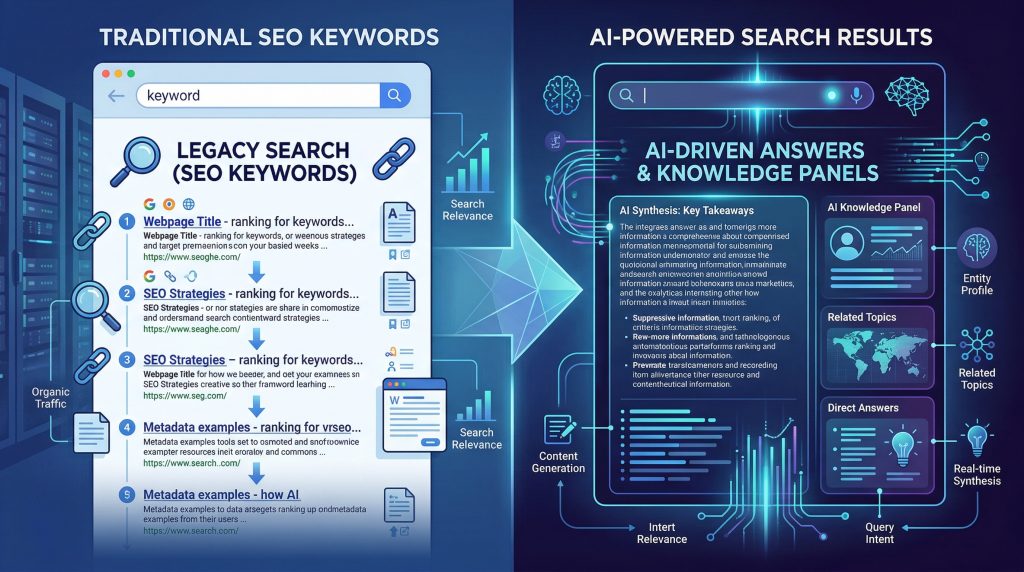
If you’ve spent any time on digital marketing in the past decade, you know SEO — Search Engine Optimization. You optimize your website so Google ranks it higher. That playbook still matters, but it’s no longer sufficient on its own.
Answer Engine Optimization (AEO) is the practice of structuring your content so AI platforms select it as the direct answer to a user’s question. When someone asks ChatGPT or Google’s AI Overview a question, AEO determines whether your content gets cited as the source.
Generative Engine Optimization (GEO) is the broader discipline of shaping how generative AI systems describe, reference, and recommend your brand across AI-generated conversations and summaries.
Here’s the simplest way to think about it:
- SEO gets you ranked on the search results page.
- AEO gets you selected as the answer within the AI summary.
- GEO shapes how AI talks about your brand when people ask about your industry.
These three disciplines aren’t competitors. They’re layers. And in 2026, you need all three working together.
How AI Decides Who Gets Cited
AI systems don’t pick sources the same way Google’s traditional algorithm does. Four factors drive it: content depth beats backlink count, concise answer blocks under 40 words get extracted 2.7x more often, freshness signals every 7-14 days keep content in the citation pool, and structured FAQ schema drives 3.1x higher extraction rates.
Each of those factors has its own playbook. We’ve broken them out into two deep-dive guides so you can go straight to the tactics that matter for your situation:
For the full answer-block writing method, step-by-step page conversion process, and AEO measurement framework: see our Answer Engine Optimization (AEO): The Complete How-To Guide.
For platform-specific tactics on ChatGPT, Perplexity, and Google Gemini, plus a citation-monitoring cadence: see our How to Get Cited by ChatGPT, Perplexity, and Google Gemini: A GEO Playbook.
Measuring Success in the New Search Reality
Traffic alone is no longer the definitive metric for search success. Track AI citations and brand mentions the way you’d track search rankings. Watch branded search volume — when AI cites you without sending a click, interested users often search your name directly. And keep tracking traditional SEO metrics alongside the new ones; AEO and GEO layer on top of your SEO foundation, they don’t replace it.
The GEO Playbook linked above covers the full weekly/monthly/quarterly monitoring cadence and tool recommendations if you want to build this out properly.
What This Means for Your Business Strategy
The transition from SEO-only to an integrated SEO/AEO/GEO approach isn’t optional. It’s happening whether individual businesses adapt or not.
The companies that will maintain and grow their search visibility in 2026 are the ones treating AI platforms as a primary discovery channel alongside traditional search. They’re optimizing for citations, not just clicks. They’re measuring brand mentions in AI responses, not just page-one rankings.
If your digital marketing strategy hasn’t accounted for the 61% drop in click-through rates caused by AI Overviews, you’re leaving visibility on the table every single day.
The playbook has changed. The businesses that recognize that first gain the advantage.
Frequently Asked Questions
What is the difference between AEO, GEO, and SEO?
SEO (Search Engine Optimization) focuses on ranking your website in traditional search results. AEO (Answer Engine Optimization) focuses on getting your content selected as the direct answer in AI-generated summaries and featured snippets. GEO (Generative Engine Optimization) focuses on shaping how AI platforms like ChatGPT, Gemini, and Perplexity describe and recommend your brand. All three work together for maximum visibility.
Are AI Overviews actually hurting website traffic?
Yes. Data from 2026 shows that organic click-through rates drop by an average of 61% on queries where Google’s AI Overview appears. Some sites have seen traffic declines of 20-40% on affected keywords. The shift toward zero-click searches means businesses need to optimize for being cited within AI answers, not just for earning clicks.
How do I check if AI platforms mention my business?
Start by directly asking ChatGPT, Perplexity, Google’s AI Mode, and Claude questions about your industry, services, and competitors. Note where and how your brand appears. Our GEO Playbook covers manual and tool-based audit methods in detail.
How often should I update content for AEO?
AI platforms, particularly Perplexity, weight content recency heavily. Research from early 2026 suggests refreshing key content every 7 to 14 days with new data points, updated statistics, or current examples. This doesn’t mean full rewrites — small, meaningful updates that signal freshness are sufficient to maintain AI citation eligibility.


