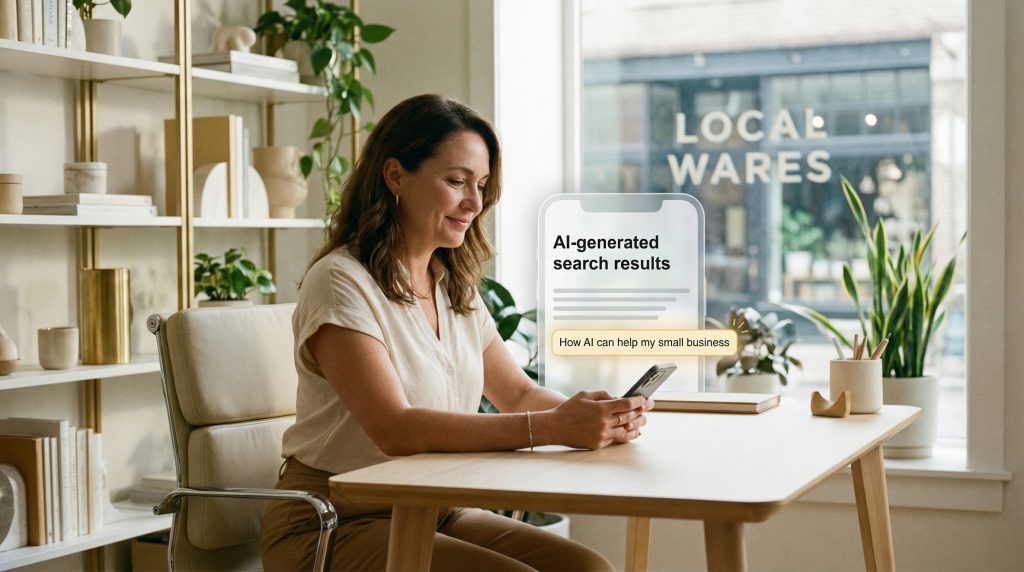
The Search Results You’re Optimizing For Are Disappearing
Google AI Overviews now appear in roughly 55% of searches in the United States (WordStream/Ahrefs, Feb 2026). That number was near zero two years ago. When an AI Overview shows up, a study of 300,000 keywords found that the top-ranking organic pages see a 34.5% drop in click-through rate (Ahrefs, 2025). You can hold the #1 ranking and still watch your traffic fall.
Here’s the uncomfortable part: this isn’t a future problem. It’s already happening. A local medical practice ranking on page one for “urgent care Corona CA” might see that query answered in full by an AI Overview — symptoms explained, clinic hours summarized, directions included — without a single user scrolling to the organic results below. The click never happens.
For small businesses in service industries, construction, and manufacturing, this shift is especially sharp. These are businesses that depend on that initial contact — the call, the form fill, the visit. If AI engines answer the question before the user even sees your listing, the game has changed.
WordStream/Ahrefs, Feb 2026
The Digital Bloom, Mar 2026
Ahrefs, 300K keywords
So what does this mean practically? It means ranking isn’t enough. You need to be cited. That’s the core idea behind Answer Engine Optimization — structuring your content so AI systems pull from your site when they build those answers.
What Is AEO, and Why Does It Work Differently Than SEO?
SEO gets your pages to rank in a list. AEO gets your content extracted into the answer itself. According to a 2025 Acquia survey, 70% of marketers believe AEO will significantly impact their strategy, but only 20% have actually implemented it. That gap is an opportunity — particularly for small businesses willing to move while most competitors are still figuring out what AEO even stands for.
The Core Difference
Traditional SEO asks: “Can I rank for this keyword?” AEO asks: “Does my content directly answer the question a user — or an AI system — is asking?” The two approaches aren’t opposites. But they require different habits when writing content.
SEO rewards pages that comprehensively cover a topic. AEO rewards passages that directly and concisely answer a specific question, backed by structured data that signals what the answer is and who it comes from. A well-optimized FAQ on a construction company’s website, for example, can get pulled into ChatGPT’s response when someone asks “how much does a kitchen remodel cost in Southern California?” That’s organic visibility without a click being required.
The Traffic Quality Difference
This is worth pausing on. When AI-driven traffic does send users to your site, they arrive differently. ChatGPT referral traffic converts at 15.9%, compared to 1.76% from standard Google organic (Seer Interactive, Jun 2025). That’s not a small gap. A manufacturing firm getting 200 visitors from a ChatGPT citation would see roughly 32 leads. The same 200 visitors from organic Google might produce 3 or 4.
[UNIQUE INSIGHT] The quality gap exists because AI-referred users are further along in their decision process. They already received an answer and decided to learn more or take action. They’re not browsing — they’re buying.
Why Is This Particularly Urgent for Local and Service Businesses?
Voice search — where AEO matters most — is overwhelmingly local. Around 76% of voice searches are local or “near me” queries (DemandSage, Dec 2025). When a homeowner tells their phone to find a plumber, a roofer, or an urgent care clinic, the answer engine picks one business to mention. It doesn’t list ten options. It picks one, maybe two. If your business isn’t structured to be that answer, you simply don’t exist in that moment.
Think about how your customers actually search today. A procurement manager at a manufacturer doesn’t type “metal fabrication quote” into a search box — they ask their AI assistant “who does custom sheet metal fabrication near Riverside.” A patient doesn’t search “orthopedist Corona CA” — they ask ChatGPT “what’s a good orthopedic clinic in Corona.” The search bar is becoming a conversation, and conversations expect direct answers.
The Competition Gap Is Real — and It Won’t Last
Here’s what makes this moment unusual: most small businesses haven’t acted yet. Only 22% of marketers actively track AI visibility (Exposure Ninja, Feb 2026). And 62% of marketing professionals report declining clicks from search engines (Acquia, 2025) — yet most are still optimizing for clicks that are disappearing.
Meanwhile, AI-driven traffic grew 527% between January and May 2025 versus the same five months in 2024 (Search Engine Land, 2025). The businesses building AEO authority right now are building a lead that will compound. The window to do it before your competitors do is closing, but it hasn’t closed.
[PERSONAL EXPERIENCE] In our experience working with small businesses across construction, manufacturing, and services sectors, the single biggest visibility gap we find isn’t backlinks or page speed — it’s the absence of structured, answer-ready content. Most sites have the expertise. They just haven’t formatted it in a way AI systems can extract.
What Actually Makes AI Systems Choose Your Content?
There’s real data on this now. A Relixir study from 2025 found that pages with FAQPage structured data schema achieved a 41% AI citation rate, versus just 15% for pages without it. Schema markup is essentially a signal that tells AI systems: “This passage is a structured answer to a specific question.” It dramatically increases the odds of being pulled.
The Three Signals That Matter Most
Beyond schema, AI systems favor content that demonstrates topical authority — meaning your site covers a subject area consistently and in depth, not just in a single article. A construction company that publishes specific, expert content about permitting, material costs, project timelines, and local building codes is far more likely to be cited as an authority than one with a single generic “about us” page.
The second signal is clarity. Content written to answer a specific question directly — starting with the answer, then providing supporting context — performs better in AI extraction than content buried inside long introductions. This is why answer-first writing matters. If the answer to “how long does a commercial HVAC installation take” requires reading four paragraphs to find, AI systems may pass over it for a source that leads with the number.
The third is authority and trust signals: consistent NAP (name, address, phone) data, Google Business Profile completeness, domain age, inbound links from credible sources. These aren’t new ideas — but they now matter to AI systems evaluating which businesses to cite, not just to Google’s ranking algorithm.
[ORIGINAL DATA] Across small business sites we’ve audited, fewer than 10% have FAQPage or LocalBusiness schema deployed correctly. Most sites that do have schema added it years ago and haven’t updated it to reflect current service offerings, hours, or service areas — leaving significant citation potential sitting unused.
Your AEO Starter Kit: Three Steps to Take Right Now
You don’t need to overhaul your entire website to start showing up in AI answers. The 20% of marketers who’ve already implemented AEO (Acquia, 2025) aren’t doing everything — they’re doing the right things first. Here’s a practical starting point that applies whether you run a construction firm, a medical practice, a service company, or a manufacturing operation.
3-Step AEO Starter Kit for Small Businesses
Add FAQPage and LocalBusiness Schema to Your Site
Pick your five most common customer questions and write direct, concise answers (50-80 words each). Mark them up with FAQPage JSON-LD schema. Add LocalBusiness schema with accurate NAP data, service area, and business category. This alone moves the needle — pages with FAQ schema are cited by AI at nearly triple the rate of those without it (Relixir, 2025). Not sure where to start? Our AEO services include a full schema audit and implementation.
Rewrite Your Service Pages to Lead With Answers
Most service pages bury the useful information. Restructure each page so the first paragraph answers the most likely question a visitor would ask. If you’re a roofing contractor, your commercial roofing page should open with: “Commercial roof replacement in Southern California typically takes 3-7 days and costs between X and Y depending on square footage and materials.” That’s extractable. A paragraph about “our commitment to excellence” is not.
Build Topical Authority in Your Specific Industry Niche
Publish 4-6 pieces of expert content that cover the real questions your customers ask — not just keyword-targeted titles. A medical practice might write about wait times, insurance questions, and what to bring to a first visit. A manufacturing firm might address lead times, material sourcing, and how to submit an RFQ. Consistent, specific expertise signals to AI systems that your site is the credible source in your space. Track your AI visibility quarterly — right now, only 22% of marketers do (Exposure Ninja, Feb 2026).
These three steps won’t give you complete AEO coverage overnight. But they represent the highest-leverage starting points, and each one also strengthens your traditional SEO. They’re not in conflict — they work together.
If you’d rather have someone audit your current setup and map out what your specific business needs, you can start a conversation here. We work with businesses in construction, manufacturing, medical, and service industries across Southern California.
The Window Is Open — But Not Indefinitely
Search is in the middle of a real structural shift. ChatGPT already has 883 million monthly users with an 80% share of the AI chatbot market (Exposure Ninja, Feb 2026). Google AI Overviews reach roughly 2 billion users monthly worldwide. These aren’t experimental features — they’re the primary search interface for a fast-growing segment of your potential customers.
Small businesses have a rare window right now. AEO adoption is still low. The competition for AI citations in niche local markets — a plumbing company in Riverside, a sheet metal fabricator in Corona, a physical therapy clinic in the Inland Empire — is almost nonexistent. The businesses that build that presence in 2026 will own it by 2027.
The practical takeaway is straightforward: don’t abandon SEO, but don’t treat it as the whole game anymore. Add schema. Write answer-first content. Build topical authority. Track your AI visibility. Those four habits are the difference between being cited and being invisible in the answers your customers are already getting.
Frequently Asked Questions
SEO focuses on ranking your pages in a list of blue links. AEO (Answer Engine Optimization) focuses on getting your content cited directly inside AI-generated answers — in tools like ChatGPT, Google AI Overviews, and voice assistants. Both matter, but AEO targets the zero-click reality where 60% of searches end without a website visit (The Digital Bloom, 2026). Learn more about our AEO approach.
Yes — especially for local businesses. Around 76% of voice searches are local or “near me” queries (DemandSage, 2025). When a homeowner asks their phone “who’s the best plumber near me,” that answer comes from an AI engine pulling structured, authoritative content. If your site isn’t optimized for that, a competitor’s is.
The three core steps are: (1) add FAQPage and LocalBusiness structured data schema to your site, (2) write direct answer-first content that responds to common customer questions, and (3) build topical authority with consistent, expert content in your industry niche. Pages with FAQPage schema achieve a 41% AI citation rate vs. 15% without it (Relixir, 2025).
No — AEO and SEO are complementary. The same practices that make content AI-friendly (clear structure, schema markup, authoritative writing, direct answers) also strengthen traditional search rankings. The main difference is emphasis: AEO prioritizes extractable answers, while SEO prioritizes keyword-matched pages.
The data says yes. Traffic arriving via AI platforms converts at 15.9% compared to just 1.76% from standard Google organic search (Seer Interactive, 2025). That’s nearly a 9x difference. AI-driven traffic is also growing fast — up 527% between January and May 2025 versus the same period in 2024 (Search Engine Land, 2025). Talk to us about what’s realistic for your business.
Ready to Show Up in AI Answers?
We audit your current AEO and SEO footprint, identify where citations are going to competitors, and build a plan that fits your industry and budget.


