
AI Customer Service Agents: Setup, Guardrails, and What to Keep Human
An AI customer service agent that answers a ticket is not the same as one that fixes it. Gartner forecasts that agentic AI will autonomously resolve 80% of common customer service issues by 2029 (Gartner, March 2025), while its October 2025 survey of 321 service leaders found only 20% had actually cut agent headcount because of AI, and it now expects half the companies that did cut to rehire by 2027 (Gartner, February 2026). Deploy one anyway, but define containment honestly, cap what it may promise, write the escalation rules before launch, and keep money, contracts, and cancellations in human hands.

A bot that answers 60% of your incoming email is not a bot that solves 60% of your customers’ problems. Everything that goes wrong with an AI customer service agent lives in the gap between those two sentences, and that gap is why ticket volume can fall for a quarter while your review average slides.
Most of what gets written about this assumes a contact center with 200 seats and a workforce management team. If you run a construction firm, a machine shop, a clinic, or a professional services office with two or three people handling everything that comes in, your problem is different. You are not optimizing a queue. You are deciding whether to put software between your customers and your staff, and what it is allowed to say when it gets there.
Deflection Is Not Resolution
Sort out the vocabulary first, because vendors use it loosely. Deflection means the ticket never reached a human. Resolution means the customer got what they needed and did not come back. Those two numbers come apart all the time.
An agent can deflect a conversation three ways that all look identical on a dashboard: it answers correctly, it answers wrongly with total confidence, or it wears the person down until they close the tab and call your competitor. The first is service. The other two are ticket suppression, and you paid for them.
So define containment before you sign anything. A containment rate worth reporting counts only conversations the agent handled from start to finish where the customer did not contact you again about the same issue within seven days and did not rate the interaction badly. Drop either clause and you are measuring silence. Silence from a customer who gave up looks the same as silence from a customer you helped, right up until renewal.
The forecasts are worth reading with that distinction in mind. Gartner’s prediction that agentic AI will autonomously resolve 80% of common customer service issues by 2029, with a 30% cut in operational costs, appears in nearly every vendor deck. The qualifier doing the work is “common.” Password resets, order status, hours, and warranty lookups are common. Your billing dispute with a general contractor is not.
The same firm’s near-term numbers are less dramatic. Gartner surveyed 321 customer service and support leaders in October 2025 and found 20% had reduced agent staffing because of AI, with most reporting flat headcount while serving more customers. It also expects that by 2027, half the companies that credited AI for headcount reductions will rehire people for similar work under different job titles. Plan for an agent that absorbs volume growth, not one that replaces your two support people.
What an AI Customer Service Agent Needs Before It Goes Live
Four dependencies. Skip one and you end up with the dead-end bot everybody complains about.
1. A knowledge base that is true today
The agent will repeat whatever you feed it, in a confident tone, forever. If your return window lives in three places and two of them are stale, expect the stale version in a customer’s inbox. Before launch, pick one authoritative source for each policy, date it, and delete the copies. This is unglamorous work and it takes longer than the technical setup.
2. Write access to your ticket system
Read-only integrations create orphan conversations. The agent needs to open, tag, assign, and close tickets, and attach the full transcript to the record, or your team ends up with two histories for one customer. If your tools do not connect natively, that plumbing is a small integration project of its own. Our comparison of n8n, Make, and Zapier costs covers what that layer runs for a small business.
3. Order and account lookups behind an identity check
Generic answers annoy people. “Your order shipped Tuesday and arrives Friday” resolves the ticket. Getting there means the agent can query your order or job system, which in turn means it has to verify who it is talking to first. Decide what proof you require, and make the lookup fail closed when it cannot confirm identity.
4. Permission boundaries in writing
This is the guardrail that matters most and gets written last. Enforce limits in the tooling, not in the prompt. A prompt is a request. An API that refuses to process a credit above $50 is a rule.
| Action | Example | Who decides |
|---|---|---|
| Answer from published policy | Hours, warranty terms, lead times, shipping rules | Agent, alone |
| Look up a record | Order status, invoice balance, appointment time | Agent, after identity check |
| Draft and send routine replies | Reschedule confirmation, tracking link, document resend | Agent, alone, logged |
| Move money | Refund, credit, discount, fee waiver | Agent below a hard dollar cap, human above it |
| Change the account | Billing details, address, plan, cancellation | Human only |
| Make a policy exception | Anything outside the written terms | Human only, never the agent |
The Escalation Contract
Write the handoff rules before you write a single answer. Customers judge you on the handoff far more than on the clever answers, so design that path first and treat it as the feature it is.
Six triggers cover most of it. Low model confidence. A second failed attempt at the same question. Any request touching money, contracts, health, or cancellation. Angry or distressed language. A complaint about the product rather than a question about it. And the obvious one: the customer asks for a person, which should work on the first ask, every time, with no loop back into the menu.
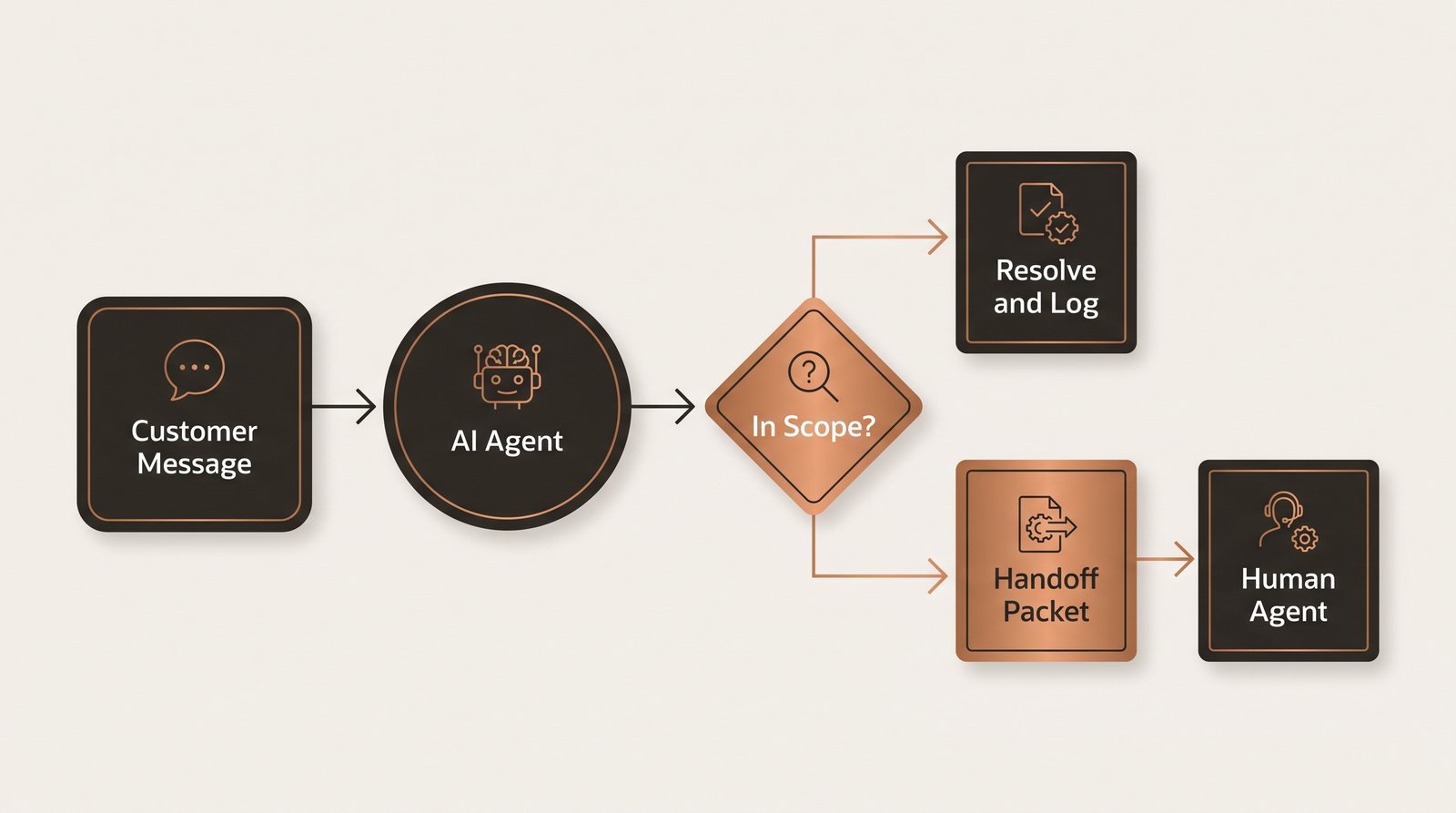
Then decide what travels with the customer. A handoff is only useful if it carries the transcript, the identified account record, what the agent already tried, and anything it promised. Your team should open the ticket already knowing the story. When context does not transfer, the customer explains the problem twice, and the second telling is angrier than the first. Zendesk’s 2026 CX Trends report, built on surveys of 6,182 consumers and 5,115 business respondents across 22 countries in June 2025, found 85% of CX leaders saying one unresolved issue is enough to lose a customer.
A dead-end bot costs more than no bot, and there is survey evidence for the instinct. Gartner’s December 2023 survey of 5,728 customers found 64% would prefer that companies did not use AI for customer service, with 53% saying they would consider switching to a competitor over it. The top worry, at 60%, was that AI would make it harder to reach a human being. Your escalation path is the answer to that fear, or the confirmation of it.
One more expectation worth designing for: the same Zendesk research found 95% of consumers want an explanation when an AI makes a decision about them, and 80% of CX leaders expect transparency to be required for customer-facing AI within two years, while only 37% offer any reasoning today. Say plainly that the customer is talking to software, and say why the answer is what it is.
Email, Chat, and Voice Are Not the Same Problem
Rank your channels by difficulty and start at the easy end.
Email is the friendliest place to begin. Nobody expects a reply in four seconds, so the agent has time to retrieve the right policy, and a human can review the draft before it sends. You also get a written record of every mistake, which is how you improve the knowledge base in month one.
Chat raises the stakes. You now have a latency budget, a customer watching a typing indicator, and a live handoff to staff who may be on the phone. Chat works well when your hours are wide and your intents are narrow, and badly when it becomes the only door.
Voice is the hardest of the three, and it is a different engineering problem under the same label. Transcription errors, crosstalk, accents, a truck idling in the background, and no scrollback for the caller to check. A caller also cannot see that a reply is uncertain, because confidence sounds the same as knowledge over a phone line. If phones are where your revenue starts, read our breakdown of AI voice agents for service businesses and the narrower case for an AI receptionist for a small business before you buy. Voice deserves its own budget and its own pilot.
Measuring It Without Fooling Yourself
Review these four every month, and put one person’s name next to each of them.
| Metric | Definition to insist on | How it gets gamed |
|---|---|---|
| Containment rate | Handled end to end, no repeat contact on the same issue within 7 days, no poor rating | Counting abandoned chats and unanswered follow-ups as successes |
| CSAT after AI handling | Surveyed on AI-only conversations, reported separately from human-handled ones | Blending both into one company-wide score |
| Reopen rate | Share of AI-closed tickets reopened or duplicated inside 7 days | Not tracked at all, or reset by opening a new ticket ID |
| Cost per contact | Platform fees, per-conversation charges, integration work, and the staff time spent reviewing | Quoting the license fee and ignoring the review and cleanup hours |
Treat vendor case studies as marketing until you can see the method. When someone claims 70% containment, ask which intents were in the sample, which were excluded, what counted as contained, how long the follow-up window ran, and who did the analysis. A 70% rate built on password resets and order lookups says nothing about how the same tool handles a disputed invoice. If the method stays hidden, run your own two-week pilot on your own tickets and compare against how you scope any other automation spend. Our guide to AI automation ROI for small business covers the payback math and the failure rates behind it.
One benchmark does come with a visible method, and it points at assist rather than autonomy. Brynjolfsson, Li, and Raymond studied 5,179 customer support agents using a generative AI assistant and found a 14% average increase in issues resolved per hour, rising to 34% for the newest and least experienced staff, with little effect on veterans (Quarterly Journal of Economics, 2025). The cheapest win available to most small teams is making the people you have faster, especially the new hire.
Five Risks Worth Planning For
Invented policies
A model asked about a policy it does not know will often produce a plausible one. In April 2025, Cursor’s front-line AI support bot told users their subscription was limited to one device. No such rule existed. The root cause was a session bug, and a co-founder had to retract the invented policy in public after users cancelled subscriptions over it (The Register, April 2025). The company now labels AI responses in email support. Ground every policy answer in retrieved text from your knowledge base, and have the agent say it does not know rather than guess.
Promises you did not authorize
The legal question is settled enough to plan around. In Moffatt v. Air Canada (2024 BCCRT 149), the airline argued that its chatbot was a separate legal entity responsible for its own actions. The British Columbia Civil Resolution Tribunal disagreed, holding that Air Canada was responsible for all the information on its website whether it came from a static page or a chatbot, and awarded damages for negligent misrepresentation (2024 BCCRT 149). That is a small Canadian claim rather than US precedent. The reasoning still travels: your bot’s statements are your statements. Cap what it can commit to in the integration layer, where a customer cannot argue with it.
Prompt injection through customer messages
Anything a customer types goes into the model’s context, which makes your support inbox an attack surface. OWASP ranks prompt injection first in its Top 10 for LLM Applications 2025, and splits it into direct injection through user input and indirect injection through content the agent ingests, such as an attached document or a linked page. OWASP’s own mitigations are the ones to copy: least privilege on tools, human approval for high-risk operations, separating untrusted content from instructions, and adversarial testing before launch. Note that OWASP considers fool-proof prevention unavailable, which is the real argument for hard spend caps. This belongs in the same review as the rest of your controls, so pair it with our small business cybersecurity checklist, and read up on how AI phishing and deepfake scams target the humans on the other side of the handoff.
Privacy and retention
Get written answers to these before launch. What customer data leaves your systems and reaches the model provider. How long transcripts and prompts are retained, by you and by the vendor. Whether your conversations can train anyone’s model, and how to switch that off. Who on your team can read transcripts. And how a deletion request flows through both the ticket system and the vendor. If you handle health or payment data, settle this with your compliance advisor before the pilot, not after.
Quiet degradation
The agent launches accurate and drifts. You change a price, add a service area, or shorten a warranty, and nobody updates the source document. Assign one person to review flagged conversations weekly and re-verify the top twenty answers monthly. That hour is the maintenance cost of the whole system.
A Four-Week Rollout
Resist the pressure to launch everything at once. The first three weeks exist to find out what your knowledge base gets wrong while no customer is watching.
- Week 1, shadow mode. The agent drafts replies and sends nothing. Your team grades every draft: correct, wrong, or unsupported by any document. Wrong answers in week one are the deliverable. They tell you which policies are stale and which questions have no written answer at all.
- Week 2, one narrow intent, live. Pick the highest-volume, lowest-risk question you have. Order status is the usual candidate. Publish the escalation path, tell customers they are talking to software, and keep a switch that turns it off in one click. Watch it daily.
- Week 3, measure and repair. Pull containment, reopen rate, and CSAT for that single intent. Read the escalated transcripts, all of them. When an answer was missing rather than wrong, fix the knowledge base and leave the prompt alone.
- Week 4, add intents. Bring in two or three more questions that share the same risk profile. Keep money, cancellations, and complaints in human hands until you have a full quarter of clean numbers.
By the end of the month you know the honest containment rate for a handful of intents, which is worth more than any vendor projection. For the wider pattern of where this fits alongside other automations, our rundown of AI agents for small business covers the use cases that pay back first.
The test your customers apply is whether they notice the seam. When the agent knows what it does not know and passes the conversation along with the whole story attached, most of them never do.
Frequently Asked Questions
What is the difference between deflection and resolution for an AI customer service agent?
Deflection means the ticket never reached a human. Resolution means the customer got what they needed and did not come back. A bot can deflect by answering confidently and wrongly, or by tiring someone out until they give up, and both of those still count as deflection in most dashboards. Insist on a containment definition that excludes any conversation where the customer contacted you again about the same issue within seven days or rated the interaction poorly.
What does an AI customer service agent need before it goes live?
Four things. A knowledge base that is accurate today, with one authoritative version of each policy. Write access to your ticket system so it can tag, assign, and attach transcripts. Order or account lookups behind an identity check, so answers are about the real customer. And permission boundaries in writing that say what it may do alone, what needs a human to approve, and what it may never touch.
When should an AI customer service agent hand a conversation to a human?
On low confidence, on the second failed attempt at the same question, on any request that touches money, contracts, health, or cancellation, on angry or distressed language, and any time the customer asks for a person. The handoff should carry the full transcript, the identified account record, what the agent already tried, and anything it promised, so the human does not restart the conversation.
Can my business be held liable for what an AI customer service agent tells a customer?
Treat it as yours. In Moffatt v. Air Canada (2024 BCCRT 149), the airline argued that its chatbot was a separate legal entity responsible for its own actions. The British Columbia Civil Resolution Tribunal rejected that and found Air Canada responsible for all information on its website, whether it came from a static page or a chatbot, awarding damages for negligent misrepresentation. Set hard spend and promise limits in the tooling rather than in the prompt.
Is voice harder than chat and email for an AI agent?
Yes. Email is the easiest because it is asynchronous, so the agent has time to retrieve the right policy and a human can review the draft before it sends. Chat adds a latency budget and live handoff. Voice adds transcription errors, interruptions, background noise, accents, and no scrollback, and a caller cannot see that the reply is uncertain. Start with email, then chat, and treat voice as its own project.
How do I judge a vendor’s case study numbers for an AI support agent?
Ask for the denominator. Which intents were included, which were excluded, what counted as contained, over what follow-up window, and who ran the analysis. A 70% containment claim built only on password resets and order-status questions tells you nothing about your refund disputes. If the method is not visible, treat the number as marketing and run a two-week pilot on your own tickets instead.
Key Takeaways
- Deflection and resolution are different numbers. Count a conversation as contained only when there was no repeat contact within seven days and no poor rating.
- Gartner’s 80% autonomous resolution forecast for 2029 applies to common issues. Its October 2025 survey found only 20% of service leaders had actually cut agent headcount, and it expects half of those who did to rehire by 2027.
- Four prerequisites: one accurate source per policy, write access to the ticket system, account lookups behind an identity check, and permission limits enforced in the tooling.
- Write the escalation contract first. Six triggers, a handoff packet with the full transcript, and a request for a human that works on the first ask.
- Email, then chat, then voice. Voice adds transcription errors and no scrollback, and hides uncertainty behind a confident tone.
- Plan for invented policies, unauthorized promises, prompt injection through customer messages, retention questions, and quiet drift as the knowledge base ages.
- Four weeks: shadow mode, one narrow intent live, measure and repair, then expand. Money, cancellations, and complaints stay human.
Wondering whether your support volume is worth automating, and which intents to start with? Talk to WinTechnology. We will look at your ticket mix, your knowledge base, and your escalation path, and tell you what to fix before you buy anything.
Written by The WinTech Desk, WinTechnology Inc. | https://www.wintechnology.ai