
AI Voice Agents for Service Businesses: The Stack, the Legal Line, and the Metrics That Matter
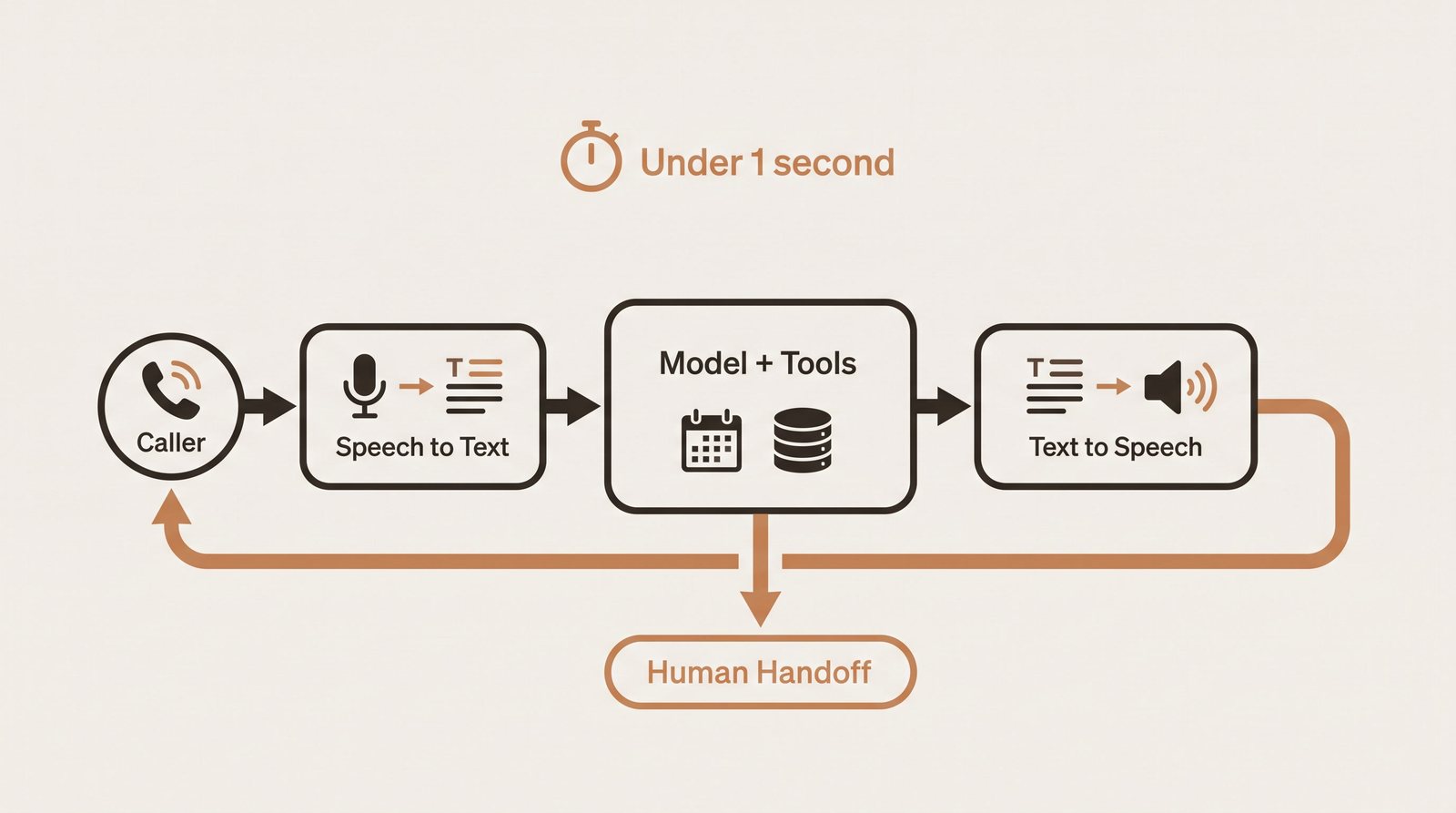
An AI voice agent is software that holds a spoken phone conversation and then does something in your systems: books, confirms, qualifies, reminds, or escalates. Four parts make it work, and the whole thing lives or dies on staying under about one second of response delay (LiveKit’s published latency budget). Inbound is a product decision. Outbound is a legal one: since February 2024 the FCC treats AI-generated voices as an “artificial voice” under the TCPA, which makes consent mandatory rather than optional.

Most owners meet voice AI through the front door: the phone rings at 7pm, nobody is there, and someone sells them a robot receptionist. Fine place to start, and we covered it separately in our guide to the AI receptionist for small business. This article is about the larger thing behind that door.
A voice agent is a general-purpose telephone worker. Once you have one that can hear, decide, speak, and write to your calendar, answering the phone is maybe a third of what it can do. The other two thirds hold most of the money and all of the legal exposure.
What an AI Voice Agent Actually Does Beyond Answering the Phone
Answering is the easiest job because the customer initiated it. They want to talk to you. They will tolerate a pause. Nobody sues you for picking up.
The jobs that pay better are the ones your staff keeps postponing. Every service business has a list of calls that should happen and do not, because whoever would make them is busy with something that feels more urgent. That backlog is the target.
| Job | Direction | Why it usually pays |
|---|---|---|
| After-hours triage | Inbound | Separates a burst pipe from a quote request at 11pm, and pages the on-call tech only for the first one. Replaces voicemail |
| Lead qualification | Inbound | Asks the four questions that decide whether a job is worth a truck roll, before anyone drives |
| Reminders and confirmations | Outbound | A reschedule found at 4pm beats an empty morning. Replaces manual call-downs |
| Quote follow-up | Outbound | Most quotes die of silence rather than price, and day three is when the silence starts |
| Review requests | Outbound | Asking by voice the day after a good job, while the customer still remembers the tech’s name |
| Payment reminders | Outbound | A polite nudge at day 20 collects better than a stern one at day 75 |
Four of the six are outbound. That split matters more than any feature comparison you will read, because the two directions are governed by different rules.
How an AI Voice Agent Is Built
Four parts, and you should know all four before a vendor demo, because the demo will hide the weak one.
Speech to text, the model, and text to speech
The traditional build chains three services. Speech to text converts the caller’s audio into words. A language model reads those words, plus your instructions and whatever your calendar and CRM report back, and decides what to say and what to do. Text to speech turns that decision into audio. OpenAI’s voice agents guide calls this the chained architecture, and its argument for it is inspectability: every stage produces text you can store, policy-check, or hand to an internal system before any speech is generated. Where a conversation is regulated, that visibility is worth real latency.
The newer option collapses the chain. A speech-to-speech model takes audio in and returns audio out, keeping reasoning and tool calls in one session. OpenAI’s Realtime API docs describe it as the best starting point for agents that need barge-in, low first-audio latency, and natural turn taking. It also speaks SIP, the protocol that carries phone calls over IP, so a number from a trunking provider can point straight at it. Faster and more natural, with less room to see what happened between hearing and speaking.
Turn-taking and interruption, the part that sounds cheap and is not
Deciding when the caller has finished speaking is the hardest problem in the stack, and the one that makes agents feel stupid when it goes wrong. The basic approach is voice activity detection: listen for silence, treat a long enough gap as the end of a turn. OpenAI’s turn detection documentation exposes the knobs, including a silence duration in milliseconds and an activation threshold. Tune the silence too short and the agent talks over a customer reading a serial number off a label. Tune it too long and every exchange carries dead air.
Silence is a poor signal for meaning, which is why the same docs offer semantic turn detection: a classifier that judges whether the words so far sound finished, with an eagerness setting from low to high. Set eagerness low for an intake call where people think out loud, high for a yes-or-no confirmation.
Interruption handling is the mirror image. When a caller talks over the agent, the agent has to stop playing audio and listen. One that finishes its sentence anyway reads as rude within two seconds, and callers hang up on rude.
Why one second is the whole game
Human conversation runs on a tight clock. A study of ten languages published in PNAS, spanning indigenous communities and major world languages, found the same pattern everywhere: speakers avoid overlapping talk and actively minimize silence between turns, with average gaps across languages falling within a 250 ms band of each other. We all run the same timing instinct, and a delay that breaks it registers as wrong before the listener can say why.
The engineering targets follow from that. LiveKit’s architecture guide tells builders to target under one second end to end from the moment the user stops speaking, and publishes the per-stage budget behind it.
Read that chart as a warning, not a spec sheet. There is 50 ms of slack in the whole loop, so any function call the agent makes during a turn, a calendar read, a customer lookup, a price check, spends money it does not have. Competent builds fetch what they can before the conversation needs it. An agent querying three systems mid-sentence always sounds worse than the demo did.
Inbound Versus Outbound, and the Legal Difference
Inbound and outbound are the same technology and different regulatory worlds. Nothing else here is as likely to cost you money if you skim it.
On February 8, 2024 the FCC adopted a Declaratory Ruling, FCC 24-17 in CG Docket 23-362, confirming that AI-generated voices fall inside the Telephone Consumer Protection Act’s restriction on calls using an “artificial or prerecorded voice.” It took effect on release, with no grace period and no small-business carve-out. If your agent calls someone with a synthetic voice, you are operating inside the TCPA.
What that means in practice, under 47 CFR 64.1200:
- Consent is the gate. Informational calls with an artificial voice need prior express consent. Anything carrying an advertisement needs prior express written consent. A number sitting in your CRM from a 2019 job is not consent for a marketing call in 2026.
- Opt-outs have a clock. A revocation made in any reasonable manner must be honored no later than ten business days from receipt. Your agent has to recognize a spoken “stop calling me” and your systems have to act on it.
- The penalty is per call. 47 U.S.C. 227(b)(3) gives the called party $500 per violation, trebled to as much as $1,500 for willful violations. Multiply by a list of 2,000 numbers and the arithmetic explains why counsel gets nervous about outbound pilots.
California adds a layer. AB 2905, signed in September 2024 as Chapter 316 and operative from January 2025, amended Public Utilities Code section 2874 to require that a call placed by an automatic dialing-announcing device inform the person called if the prerecorded message uses an artificial voice, defined as a voice generated or significantly altered using artificial intelligence. Other states have moved the same way, so if you call across state lines, design against the strictest rule in your footprint.
We are an automation firm, not a law firm, and none of the above is legal advice. Treat it as the reason to book an hour with your own attorney before your first outbound campaign.
The operational takeaway is simpler than the citations suggest. Start inbound, where there is no consent problem because the customer dialed you, and learn how your agent behaves on real calls. Then add outbound one narrow case at a time, beginning where consent is cleanest: confirming an appointment the customer booked themselves, with a disclosure in the opening line and an opt-out honored on the spot.
Build, Buy, or Hire Someone to Run It
Three paths, and the maintenance column is the one vendors skip.
| Path | What you get | What it asks of you | Best fit |
|---|---|---|---|
| Platform, self-configured | Telephony, turn detection, recording, transcripts, a prompt editor, calendar connectors | Someone in-house who owns the prompts and listens to recordings. A few hours a week indefinitely, not a one-time setup | One clear use case and a capable operations person |
| Platform plus agency | The above, plus scripting, CRM and calendar integration, escalation design, call review | A monthly fee and honest feedback about what the agent got wrong. The work sits in the integration, not the voice | Most service businesses, especially where the agent touches scheduling or money |
| In-house build | Full control over the model, the prompts, the data, and the cost curve | A developer who stays. APIs change, models get deprecated, telephony misbehaves. A permanent line item, not a project | High volume, an unusual workflow, or a rule against third-party recording |
One honest warning about the in-house path: the build is the cheap part, which is exactly what makes the decision look easy. A competent developer can wire a working agent against a realtime API in a couple of weeks. The expensive part is year two, when the calendar edge case nobody anticipated meets the model version that changed how the agent handles ambiguity, and the recording review stopped happening because the developer moved on. Our comparison of n8n versus Make versus Zapier covers the same tradeoff one layer down, with the same answer: own what you need to control, rent what you only need to work.
Whichever path you pick, the rollout discipline matches any other agent deployment. Our 30-day playbook for getting started with AI agents walks through the shadow-pilot pattern, which matters more for voice than anywhere else. Run the agent alongside your existing process, listen to the recordings, then let it answer live.
How to Measure an AI Voice Agent
Five numbers. Pull them weekly for the first month and monthly after that, and refuse to judge the agent on anything else.
Containment rate is the share of calls resolved without a human. It is the headline number and the easiest one to game. An agent that never transfers looks superb in a dashboard while irritating every caller who needed a person, so containment only means something read next to abandonment and complaints.
Transfer rate counts how often the agent hands off, and how often that handoff reaches a human who can help. A transfer into an unanswered queue is worse than no agent, because the caller spent ninety seconds to arrive at hold music. Measure connected transfers, not attempted ones.
Booking rate is only meaningful against a baseline. Pull two weeks of human-handled calls before launch, or you will have no way to tell a good agent from a mediocre receptionist.
Call abandonment is your frustration meter, and the number that catches latency problems, bad turn detection, and loops. Watch where in the call it happens. A cluster of hangups at the same question means that question is broken.
Cost per resolved call is total monthly cost divided by calls resolved without a human. Count platform fees, telephony, model usage, and the staff hours spent reviewing recordings and fixing scripts. That last item is the one businesses forget, and in month one it is often the largest. Compare it against the loaded cost of the staff time the agent displaced, the same discipline we apply in our breakdown of AI automation ROI for small business.
Failure Modes, and the Guardrails That Catch Them
Voice agents fail in a small number of predictable ways, and the fix is almost always a constraint rather than a better prompt.
Hallucinated commitments. The agent invents an arrival window, a price, or a policy, and the customer heard a promise. The guardrail is architectural: give it read access to real availability and a real price list as tools, and instruct it to say it will confirm rather than guess when a tool comes back empty. Never let an agent quote a binding price. A range with an explicit “a technician will confirm on site” is fine. A number the customer can hold you to is not.
Loops. The agent asks the same question three times because it cannot parse the answer, usually a street name or a part number. Cap repeats per question at two, and cap the conversation with a turn limit that routes to a human on the way out.
No escalation path. The most common design failure. If a caller cannot reach a person by asking, you built a trap. Escalation should trigger on an explicit request, on detected frustration, and on any topic you flagged out of scope, and it should be offered out loud early in the call.
Silent drift. The agent worked in March and is mishandling a common question by July, because a model changed or your services did. Nobody notices, because nobody listens to calls once the novelty fades. Put a recurring twenty-minute recording review on someone’s calendar.
Wrong job for a voice agent. Some conversations should not be automated: a distressed customer, a warranty dispute, anything where the next step is a negotiation. Write that exclusion list before launch. A good agent knows what it is not for, and the case for scoping agents narrowly runs through our guide to AI agents for small business.
Frequently Asked Questions
What is an AI voice agent, and how is it different from an AI receptionist?
An AI voice agent is software that holds a spoken phone conversation and then takes an action in your systems: booking a slot, confirming an appointment, qualifying a lead, logging a note, or handing the call to a person. An AI receptionist is one job that a voice agent can do, and it is inbound only. The same underlying stack also runs outbound work such as reminders, confirmations, review requests, and payment nudges, which is where the technical and legal requirements change.
Are AI voice agent calls legal for outbound calling?
Outbound calls with a synthetic voice are legal only with the right consent. On February 8, 2024 the FCC adopted a Declaratory Ruling (FCC 24-17, CG Docket 23-362) confirming that AI-generated voices count as an artificial voice under the Telephone Consumer Protection Act, effective on release. That means prior express consent for informational calls and prior express written consent for marketing calls under 47 CFR 64.1200. Statutory damages run $500 per violation and up to three times that for willful violations under 47 U.S.C. 227(b)(3). This is general information, not legal advice. Have your own counsel review any outbound program.
How fast does an AI voice agent have to respond to sound normal?
Aim for under one second from the moment the caller stops talking to the moment your agent starts talking. LiveKit’s published budget for a natural-feeling agent allocates under 50 ms for WebRTC transport, 100 to 200 ms for the first speech-to-text partial, 200 to 400 ms for the model’s first token, and 100 to 300 ms for the first audio out. Human conversation sets the bar: a ten-language study in PNAS found speakers consistently minimize silence between turns, with cross-language averages falling within a 250 ms band.
Should a small business buy a voice agent platform, hire an agency, or build in-house?
Most service businesses under roughly 50 employees should buy a platform and pay someone to configure it properly. A platform gets you telephony, turn detection, and call recording out of the box. An agency adds the scripting, calendar and CRM integration, and escalation design, which is where the value actually sits. Building in-house only pays off when call volume is very high or the workflow is unusual, and the honest cost is ongoing: prompts, vendor model changes, calendar edge cases, and recording review never stop.
Which metrics show whether an AI voice agent is working?
Track five: containment rate (share of calls resolved without a human), transfer rate and whether transfers connect, booking rate against your human baseline, call abandonment (callers who hang up mid-conversation), and cost per resolved call including platform fees, telephony, model usage, and the staff time spent reviewing recordings. Containment on its own is misleading, because an agent that refuses to transfer looks excellent right up until the complaints arrive.
What should an AI voice agent never be allowed to do?
Never let it quote a binding price, promise an arrival window your schedule cannot support, commit to a warranty or refund, or give advice in a regulated area such as medical, legal, or financial. Give it read access to real availability rather than letting it improvise, cap the conversation with a turn limit that routes to a human, and make escalation available on any request plus any detected frustration. Review recordings weekly for the first month.
Key Takeaways
- Answering the phone is the smallest job. Reminders, confirmations, quote follow-up, review requests, and payment nudges are the outbound calls your staff already skips, and where a voice agent usually earns its keep.
- The stack is speech to text, a model, text to speech, and turn detection. Turn detection decides whether callers find the agent usable, and silence alone is a poor signal for meaning.
- Target under one second end to end. LiveKit’s per-stage budget spends 950 ms of the available 1,000, so one mid-turn lookup against a slow system breaks the illusion.
- Outbound is a legal question first. FCC 24-17 put AI-generated voices inside the TCPA’s artificial voice restriction on February 8, 2024: consent required, opt-outs honored within ten business days, exposure of $500 per call and up to $1,500 for willful violations, plus California’s AB 2905 disclosure.
- Buy the platform, pay for the integration, budget for permanent maintenance. Then measure containment, connected transfers, booking rate against a human baseline, abandonment, and cost per resolved call. Never let the agent quote a binding price, and always leave a working door to a person.
Wondering which of your phone calls should be automated first, and which ones never should? Talk to WinTechnology. We will map your call types, flag the ones with a consent problem, and tell you where a voice agent pays for itself.
Written by The WinTech Desk, WinTechnology Inc. | https://www.wintechnology.ai