AI Receptionist for Small Business: What It Does, Where It Breaks, and How to Launch One
An AI receptionist answers your business line in a real-sounding voice, asks the questions you told it to ask, books into your live calendar, transfers the calls that need a person, and texts the caller afterward. It is not a phone tree and not a website chatbot. It earns its keep where unanswered calls cost real money: trades, dental and medical offices, law firms, salons. Vendors bill on four different meters, so quoted prices rarely compare. Two things decide whether yours works: an escalation rule that puts a human on the line fast, and somebody reading transcripts every week. Gartner found 87% of customers say a company using generative AI for service must still give them a route to a person (Gartner, August 2026).

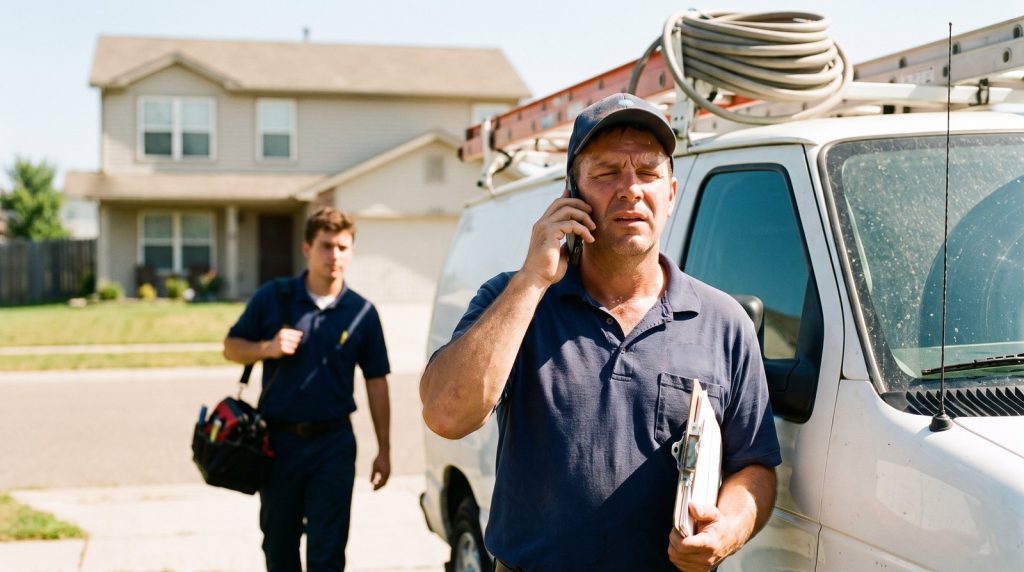
Two-truck HVAC shop, July, 11 in the morning. Both techs are in attics. The owner is on a ladder with a manifold gauge in one hand. The office phone rings for the fourth time that hour, rolls to voicemail, and the caller does not leave a message. She calls the next company on the map.
That call was worth a $9,000 changeout, and nobody logged it, so nobody grieved it. AI receptionists exist for that gap, which is also why they are easy to oversell.
What Is an AI Receptionist?
An AI receptionist is software that answers your phone line, talks with the caller in ordinary speech, and does work during the call: qualifying the job, checking a live calendar and booking a slot, routing an urgent call to a person, texting a confirmation. Then it leaves you a transcript.
Two older things get confused with it. An IVR phone tree is a recording plus a keypad. It understands nothing and makes the caller walk your org chart on a phone they are holding with their shoulder. A website chatbot is text on a page, so it reaches only people who found your site and chose to type. Most service callers tap the number in a Google result instead.
| IVR phone tree | Website chatbot | AI receptionist | |
|---|---|---|---|
| Where it lives | Phone system | Your website | Your phone line |
| Caller input | Keypad presses | Typing | Talking |
| Handles a full sentence | No | Yes | Yes |
| Books a real calendar slot | No | Sometimes | Yes, when wired to it |
| Reaches a human mid-call | Transfers blindly | Rarely | Yes, on rules you write |
| What you maintain | Menu tree, recordings | Prompts, knowledge base | Prompt, escalation rules, integrations, transcripts |
Which Small Businesses Need One?
Three conditions have to hold at once: a single call is worth real money, the people who could answer are physically occupied, and callers will not wait or try again.
Owners underrate that third one. CallRail’s January 2025 report analyzed 1.1 million de-identified conversations across six verticals, and its survey of 1,000 US consumers found 42% say they leave a voicemail (CallRail, 2025). Calling back later does not rescue you either: Hiya’s survey of more than 12,000 consumers found 46% of calls from an identified legitimate business go unanswered (Hiya). Both are vendor-owned, and Hiya measures outbound answer rates rather than inbound misses, so read them for shape. The shape says your 6pm callback from an unsaved number is not a recovery plan.
- Trades and home services. The dispatcher and the technician are often the same person, and that person is under a sink. Calls cluster in the hours crews are busiest, then spike after 5pm when homeowners find the water heater cold.
- Dental and medical practices. High volume, appointment-driven revenue, and a front desk that also serves whoever is standing in front of it. The catch is HIPAA, covered below, and it is not optional.
- Law firms. Intake speed decides who gets the client. An agent can take the name, matter type, and deadline, then book a consultation. It must not give legal advice, run a conflict check, or quote a fee.
- Salons, spas, and studios. Booking and cancellations taken while someone’s hands are in a client’s hair. High volume, low stakes per call, and the calendar is the business.
Plenty of shops should skip this. Three calls a day does not justify the setup work, and where every job needs a site visit the agent can only take a message, which voicemail already does.
How Does an AI Receptionist Work, End to End?
Five links in a chain. Any one of them can break the call, so it pays to know what sits where before a salesperson tells you it just works.

1. The phone number
Three routes. Forward your existing line: Goodcall describes keeping “your existing business line and simply forward calls to your new agent” through conditional forwarding at your provider (Goodcall). Forwarding on ring-no-answer is the safest first setup, because the agent picks up only what a human let ring out. Bring your own number: Vapi documents importing numbers you own from Twilio using your Twilio credentials (Vapi docs). Connect a SIP trunk: Retell documents elastic SIP trunking through Twilio with separate termination and origination settings (Retell docs), and ElevenLabs documents SIP trunking with TLS transport across “most standard SIP trunk providers” (ElevenLabs docs).
2. Speech in, speech out
The caller’s audio becomes a running transcript in near real time, and the reply becomes audio again. Twilio’s ConversationRelay “manages speech recognition, text-to-speech, and voice synthesis” while you supply the reasoning layer (Twilio docs). Transcription is the link that suffers on a noisy job site, and no amount of prompt tuning fixes bad input.
3. The model
A language model reads the transcript, decides what to say next, and decides whether to call a tool. Your prompt is the script, the boundaries, and the escalation policy in one document. Whatever you leave out, the model fills in, and that is the source of most bad calls.
4. Calendar and CRM tools
Tools separate a message-taker from a receptionist. Vapi documents a Google Calendar Check Availability tool and a Create Event tool, connected through an authorization popup rather than an API key (Vapi docs). Bland lists Cal.com and Calendly for scheduling, plus Salesforce and HubSpot (Bland). Synthflow lists trade and practice systems including ServiceTitan, Jobber, and Dentrix (Synthflow). Confirm your actual scheduler is on the list, not a cousin of it. And one rule outranks the rest: availability comes from a calendar lookup during the call, because a model asked to guess at open slots will produce a plausible time nobody has.
5. The human handoff
The most underrated feature in the category. Retell documents a cold transfer, where “the call goes straight to the destination and your agent drops off right away,” a warm transfer, where the agent “stays on the line after dialing the destination,” and an agentic version where a second agent briefs the destination first (Retell docs). ElevenLabs states that warm transfer messages are “only available when the agent’s phone number is imported via the native Twilio integration” and that “SIP-based transfers do not support warm transfer messages” (ElevenLabs docs). Read that limitation twice: the transfer you saw in a demo may not survive the telephony path you deploy on. Test your handoff on your own setup, day one.
Then the call ends and you get the transcript, a summary, a text to the caller, and a CRM record. That last mile is ordinary plumbing, and our walkthrough of AI workflow automation for small business covers where it leaks.
What Does an AI Receptionist Cost?
Less than a receptionist, more than you were quoted, and priced in units that resist comparison. An owner holding three quotes is usually comparing minutes to calls to customers.
| Meter | How you are billed | Examples |
|---|---|---|
| Unbundled per minute | Platform, transcription, model, voice, and telephony priced separately, so long calls and premium voices both move the bill | Retell: voice infrastructure $0.055/min, text to speech from $0.015/min, model and telephony on their own lines, advanced denoising $0.005/min. Vapi: $0.05/min hosting plus provider costs passed through |
| All-in per minute plus platform fee | One blended rate covers model, transcription, and voice. Transfer minutes bill separately | Bland: $0.14/min with no platform fee, or $0.12/min with a $299 monthly fee, stating “No token charges. No model-provider pass-throughs” |
| Subscription with included minutes | A monthly tier bundles minutes, then charges overage. Call spikes past your concurrency limit cost more | ElevenLabs Agents: $0.080/min standard and $0.160/min above the concurrency limit, tiers from free to $990/month, model and telephony at cost |
| Flat monthly, or per call | A fee per agent or per handled call, capped on something other than time | Goodcall: $79, $129, and $249/month with “unlimited minutes and tokens,” capped at 100, 250, and 500 unique customers and $0.50 per customer beyond. Smith.ai: $3.00/call, or $150/month plus $2.00/call |
Every figure there came off the vendor’s own pricing page in September 2026, and those pages change often. Synthflow’s public pricing now shows one enterprise tier starting at $30,000 annually (Synthflow), a fair warning that a platform sized for a five-person shop last year may have moved upmarket since.
Do the arithmetic once and comparison gets easy. Estimate answered calls per month and average length: 200 calls at three minutes is 600 minutes. Run that through each meter, then add transfer minutes and the number rental. The ranking flips at least once. For payback math, see AI automation ROI for small business.
Where AI Receptionists Fail
Four failure modes. Three yield to configuration. The fourth is a legal problem wearing a technical costume.
Accents and noisy job sites
Speech recognition accuracy is not uniform across speakers, and that is measured rather than guessed. A peer-reviewed PNAS study tested five commercial systems against 19.8 hours of matched audio from 115 speakers and found an average word error rate of 0.35 for Black speakers against 0.19 for white speakers (Koenecke et al., PNAS 2020). It tested 2019-era systems on dialect rather than noise, so read it as evidence about the problem, not a benchmark for anything sold today. The lesson survives: whose voice a model learned from changes what it hears. On noise, vendors admit the limits themselves. Vapi’s docs call their Fourier denoising option “highly experimental,” noting it “can introduce audio artifacts or distortions” (Vapi docs).
Complicated and emotional calls
Callers arrive skeptical. A Gartner survey of 5,728 customers found 64% would prefer companies did not use AI for customer service, and 60% worried it would make reaching a human harder (Gartner, July 2024). You get one attempt, too: Gartner reported in September 2026 that only 27% of customers would try a chatbot again after a bad experience (Gartner, September 2026). Design around that. A caller who says “person,” “human,” or “representative,” or who raises their voice, should be on a transfer path within one turn. Complaints, billing disputes, and anything with the word emergency belong to a person.
Invented availability and made-up policy
A model asked a question it cannot answer will produce something that sounds correct: a Tuesday slot nobody has, a warranty term you never offered, a price you would never quote. The fixes are structural. Facts come from tool calls. Prices and policies live in a knowledge base with narrow answers. And the prompt needs a script for not knowing, which is one sentence and a callback. Our guide to AI agents for small business covers the same guardrail pattern off the phone.
Compliance, where the real risk sits
HIPAA. HHS defines a business associate as an entity that creates, receives, maintains, or transmits protected health information on behalf of a covered entity, and its guidance names AI chatbots among the examples. The covered entity must obtain written assurances in a business associate agreement before disclosing PHI, and the obligation flows down to subcontractors (HHS). An agent that hears a caller’s name, number, and reason for the appointment is handling PHI, and so are the transcription, model, and telephony providers behind it. The BAA gate is where the budget surprise hides. Retell says its agreements can be self-signed at no additional fee (Retell). ElevenLabs states BAA execution is “only available for Enterprise tier subscriptions” (ElevenLabs). Bland lists HIPAA as self-attested with a BAA, next to a SOC 2 Type II audited by an independent third party (Bland). Ask about that distinction out loud.
Recorded calls, and California in particular. We are in Corona, so this one is close to home. Penal Code 632 makes it an offense to record a confidential communication “without the consent of all parties” (632). Section 632.7 goes further, covering any call involving a cellular or cordless phone with no confidentiality test at all (632.7). Since most inbound calls come from mobiles, 632.7 is the section that governs you. In Smith v. LoanMe (2021) the California Supreme Court applied it to a business recording its own call, where the company sounded one beep and never said it was recording. A spoken notice at the start is the defensible pattern. None of this is legal advice, and the fifteen minutes your attorney spends on your greeting script is the cheapest part of the project.
Does the agent have to say it is an AI? As of September 2026, no federal rule makes an inbound AI receptionist announce itself. The FCC’s declaratory ruling in CG Docket 23-362, adopted 2 February 2024, held that AI-generated voices are artificial under the TCPA and require prior express consent (FCC, February 2024), and it governs outbound calls placed to consumers, not calls a consumer places to you. The FCC proposed a disclosure requirement in August 2024, comments closed that October, and no final rule has been adopted (FCC NPRM). California’s bot-disclosure law misses phone calls too, since Business and Professions Code 17940 defines “online” as a public-facing website, web application, or digital application (17940). Utah does require verbal disclosure at the start of a verbal interaction in defined cases. Disclose anyway. A caller who works out mid-sentence that they were fooled remembers your company for the wrong reason.
The Go-Live Checklist
Seven steps, in this order. The first three get skipped most often, and they are why most pilots embarrass someone.
- Pick two or three call types, not all of them. For a trades business: a quote request, an existing customer rescheduling, and anything arriving after hours. Everything else keeps ringing through to a person.
- Write the escalation rules before the script. Name the triggers: the caller asks for a person, the caller uses an emergency word you chose in advance (gas, smoke, flood, chest pain, bleeding), the agent misunderstands twice, the topic is billing or a complaint. Then name where each one goes, including after hours.
- Record a real greeting. Your name, your company, your words, and the recording notice if you are recording. The stock vendor greeting tells a caller you outsourced them to a robot.
- Wire availability to the live calendar. Read from the same calendar your crews work off, and write back to it. If the agent cannot check real availability, do not let it offer times at all.
- Test with your own hardest calls. Call from a truck with the engine running, and from a job site with a compressor going. Have the customer with the thickest accent in your book call, and the one who talks fastest. Try to break the transfer, and try to make it invent a price.
- Settle consent and disclosure. Recording notice at the top, reviewed by your attorney. A BAA in hand before a single medical call lands. One plain sentence identifying the agent as an assistant.
- Read transcripts weekly. Twenty minutes, same slot every Friday, counting four things: booked, transferred, misunderstood, abandoned. The misunderstood pile is your prompt backlog. Skip this and the agent degrades while your dashboard says everything is fine.
A sane pilot runs four to six weeks: after hours only for two weeks, then overflow during business hours, then a decision. Our 30-day playbook for getting started with AI agents uses the same staged shape, and a receptionist slots into the wider small business AI marketing stack once the calls it books feed your CRM.
Frequently Asked Questions
What is an AI receptionist, and how is it different from a phone tree?
An AI receptionist answers your business line in a synthetic voice, holds an open-ended conversation, and acts during the call: qualifying the caller, checking a live calendar and booking, transferring urgent calls, and texting a follow-up. A phone tree plays a fixed menu and waits for a keypress. It cannot understand a sentence, check your calendar, or decide that a call needs a human right now.
How much does an AI receptionist cost?
Vendors bill on four meters, so headline prices rarely compare: unbundled per minute, one all-in per-minute rate plus a platform fee, a subscription with included minutes and an overage rate, or a flat monthly or per-call fee. Estimate your monthly answered minutes and call count, then run that through each meter. Published rates change often, so check the vendor’s own pricing page before you budget.
Can an AI receptionist be HIPAA compliant for a dental or medical practice?
Only with a signed business associate agreement. HHS defines a business associate as an entity that creates, receives, maintains, or transmits protected health information on a covered entity’s behalf, and its guidance names AI chatbots among the examples. An agent that hears a caller’s name, number, and reason for the visit is handling PHI. Some vendors let you self-sign a BAA at no extra cost, some sell HIPAA as a paid add-on, and some restrict BAAs to enterprise contracts. Ask which tier the BAA requires first.
Do I have to tell callers they are speaking to an AI?
As of September 2026 no federal rule requires an inbound AI receptionist to announce itself. The FCC’s February 2024 declaratory ruling held that AI-generated voices count as artificial under the TCPA, but it governs outbound calls placed to consumers. The FCC’s August 2024 disclosure proposal has not been adopted, and California’s bot-disclosure law covers public-facing websites and apps rather than phone calls. Disclose anyway, because callers who feel tricked stop calling.
Is it legal to record calls with an AI receptionist in California?
Only with consent from every party. California Penal Code 632 bars recording a confidential communication without the consent of all parties, and 632.7 covers any call involving a cellular or cordless phone with no confidentiality test at all, which describes most inbound calls today. In Smith v. LoanMe (2021) the California Supreme Court held that 632.7 reaches a business recording its own call, and indicated a bare beep may not be adequate notice. Use a spoken notice at the top of the call and have your attorney review the wording.
Where do AI receptionists still fail?
Four places. Noisy job sites and speakers the speech model was not trained on. Emotional or complicated calls, where Gartner found only 27% of customers would try a bot again after one bad experience. Invented answers, when the agent guesses at availability instead of calling a tool. And compliance, where a missing BAA or a recording without consent becomes a legal problem rather than a service problem.
Key Takeaways
- An AI receptionist answers the line, qualifies the caller, books a live calendar slot, transfers on rules you write, and texts a follow-up. A phone tree does none of that.
- The fit test is three conditions at once: calls worth real money, staff who are physically occupied, and callers who will not wait.
- Availability must come from a real calendar lookup. An agent guessing at open slots will offer a Tuesday nobody has.
- Compare the four pricing meters by running your own volume through each, and pull current rates first. One platform here now starts at a $30,000 annual minimum.
- Escalation is the product. Gartner found 87% of customers insist on a route to a human, and only 27% would give a bot a second try after one bad call.
- In California, Penal Code 632.7 governs recording on any call from a cell phone, and Smith v. LoanMe applies it to a business recording itself. Get a spoken notice, plus a BAA for medical work.
Weighing an AI receptionist for your shop, practice, or firm? Talk to WinTechnology. We will map your call types, draft the escalation rules, and tell you plainly if your call volume does not justify one yet.
Written by The WinTech Desk, WinTechnology Inc. | https://www.wintechnology.ai