
How to Get Cited by ChatGPT: Why Most Retrieved Pages Never Make the Answer, and What to Fix
ChatGPT reads far more pages than it credits. In a study of 548,534 pages ChatGPT retrieved across 15,000 prompts, only 15% were cited in the final answer (AirOps, 2026). Getting cited takes two separate wins. First, get found: allow OAI-SearchBot and make sure Bing has indexed you. Second, get chosen: pages with a tight title-to-question match, a direct answer near the top, facts nobody else has, and a brand that other sites talk about.

Ask ChatGPT for “the best commercial roofing contractors in the Inland Empire” and watch the little source chips at the bottom of the answer. Three or four sites get credit. What you don’t see is the pile of pages ChatGPT pulled up, skimmed, and dropped before writing a word.
A lot of small business websites live in that hidden pile: indexed, fetched now and then, and never named. If you already know the basics of answer engines (our AEO vs GEO vs SEO explainer covers them), this guide goes one level down: how ChatGPT search picks its sources, why being retrieved and being cited are two different contests, and a fix list you can work through in a month.
How Does ChatGPT Search Find Sources?
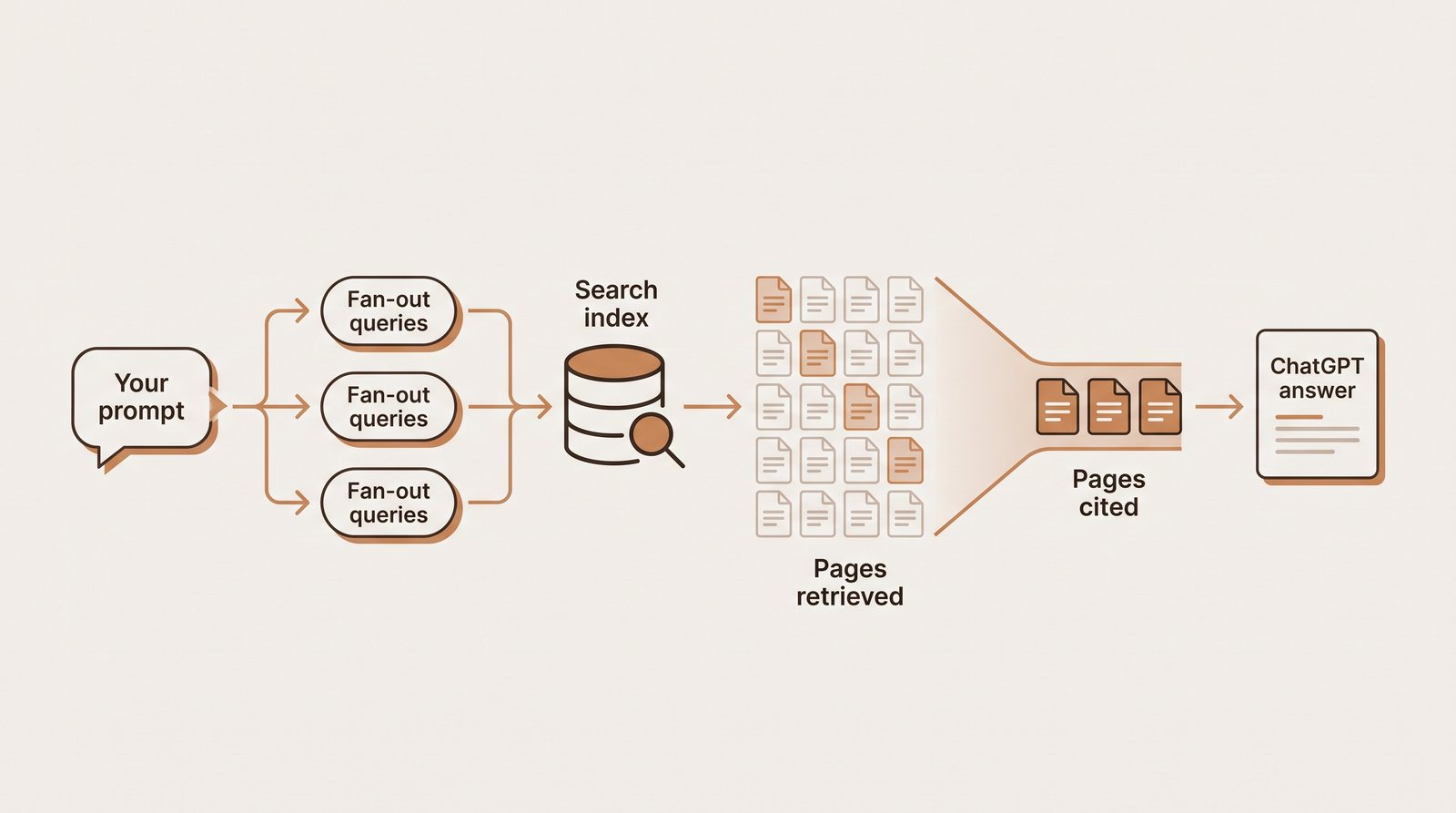
ChatGPT search pulls from two places: OpenAI’s own crawler and outside search providers. When you ask a question that needs current information, ChatGPT rewrites your prompt into one or more shorter search queries and sends them out. OpenAI’s help article on ChatGPT search describes the process: it “sometimes partners with other search providers,” rewrites the question into targeted queries, and may send follow-up queries after reviewing the first results. The providers it lists for privacy purposes include Microsoft, which runs Bing.
The other half is OAI-SearchBot, OpenAI’s search crawler. OpenAI’s crawler documentation spells out three separate user agents, and mixing them up is an easy way to hide from ChatGPT by accident:
| User agent | What it does | If you block it |
|---|---|---|
| OAI-SearchBot | Crawls sites so they can appear in ChatGPT’s search features | Your pages “will not be shown in ChatGPT search answers,” per OpenAI |
| GPTBot | Collects content that may be used to train OpenAI’s foundation models | Opts you out of training. It does not remove you from ChatGPT search |
| ChatGPT-User | Fetches a page when a person in ChatGPT asks it to, rather than crawling on a schedule | OpenAI notes robots.txt rules may not apply, since a user triggered the visit |
So a business that wants search visibility without feeding model training can allow OAI-SearchBot and disallow GPTBot. OpenAI says changes to robots.txt take about 24 hours to reach its systems. Its publisher FAQ adds a second requirement people forget: your host or CDN has to allow traffic from OpenAI’s published search bot IP addresses. A firewall rule that treats every unfamiliar bot as an attacker can undo a perfect robots.txt without anyone noticing.
How much does Bing matter?
More than most owners assume. Seer Interactive ran the same questions through ChatGPT search and through Bing and Google, then matched the citations. 87% of ChatGPT’s citations matched Bing’s top organic results, against 56% for Google. Seer called the 100-query sample directional, and the test ran in early 2025, so treat it as a strong hint rather than a law. Still, the practical takeaway holds up: if Bing hasn’t indexed a page, you have removed one of the main roads ChatGPT uses to find it.
Plenty of small businesses have never opened Bing Webmaster Tools. They verified Google Search Console years ago and stopped there.
Retrieved vs Cited: Why Most Pages Never Get Credit
Getting fetched is the easy part. Two large 2026 studies measured the gap between the pages ChatGPT looks at and the pages it names.
AirOps analyzed 548,534 retrieved pages across 15,000 prompts and found only 15% were cited. Ahrefs studied 1.4 million prompts and put the overall citation rate near 50%. The two numbers measure different things. Ahrefs split retrieval by source type, and ordinary web search results were cited 88.46% of the time, while Reddit, YouTube, and academic results were almost never credited. AirOps counted everything ChatGPT pulled in during a session. Different definitions, same lesson: a big share of what ChatGPT reads never shows up in the answer.
The Reddit number deserves a second look. Ahrefs counted 16.1 million Reddit URLs retrieved, yet Reddit made up 67.8% of all the URLs ChatGPT didn’t cite. ChatGPT reads Reddit threads to gauge what people think about a topic and then credits somebody else. For a business, that means Reddit shapes the answer without ever sending you a link.
The fan-out problem
ChatGPT seldom stops at one search. AirOps found that 32.9% of cited pages showed up only in the results for a follow-up “fan-out” query, never for the original prompt. And 95% of those fan-out queries had zero monthly search volume in keyword tools. Your keyword tracker cannot see most of the searches that decide whether you get cited.
A homeowner asking about a water heater replacement might trigger fan-out searches like “tankless water heater install cost Riverside 2026” or “tankless vs tank gas bill comparison.” Almost nobody types those into Google, so they register no volume. ChatGPT types them all day.
What Earns a ChatGPT Citation?
Five traits keep showing up in the research on cited pages.
1. Titles and passages that match the question
Relevance at the passage level is the strongest lever you control. In the AirOps data, pages whose titles overlapped the query by 50% or more were cited 20.1% of the time, against 9.3% for pages with under 10% overlap. Ahrefs found the same pattern using semantic similarity: cited pages had titles closer to the prompt than pages that were retrieved and skipped. Ahrefs also saw a higher citation rate for readable, natural-language URLs (89.78%) than for opaque ones (81.11%).
In practice, a page titled “Commercial Roof Coating Cost per Square Foot in Southern California” beats a page titled “Our Services” for almost every question a buyer asks ChatGPT. Put the answer in the first two sentences under each heading. ChatGPT lifts passages, so a passage that can stand alone gets lifted. Our AEO how-to guide walks through answer-first formatting in detail.
2. Something only you can say
If ten sites say the same thing, ChatGPT has no reason to cite yours. Original material gives it one. For a small business that rarely means a formal research study. It means your actual price ranges, your typical project timelines, the permit steps in your county, the five questions customers ask on every sales call, or a spec comparison from real installs. Write the number down with its context and date. An AI model looking for a specific figure will cite the page that has it.
3. Mentions on other people’s sites
Your own site is one voice. Mentions elsewhere tell the model your business is real and relevant. In an Ahrefs study of 75,000 brands, ChatGPT visibility correlated with YouTube mentions at 0.712 and branded web mentions at 0.664, while Domain Rating came in at 0.266. Ahrefs also found ChatGPT showed the weakest link to traditional authority signals of the three AI tools it tested, which is good news for smaller companies. You don’t need a huge backlink profile. You need people talking about you: trade association listings, supplier case studies, local news, review sites, industry podcasts, and yes, Reddit threads where a real customer mentions you by name.
4. Freshness, within reason
AI assistants lean newer than Google. Ahrefs looked at nearly 17 million cited URLs and found AI-cited pages averaged 1,064 days old versus 1,432 days for Google organic results, about 25.7% fresher. ChatGPT had the strongest lean, citing URLs 458 days newer than Google’s results on average. Freshness helps, but relevance still wins. Ahrefs’ 2026 citation study found the average page ChatGPT cited was around 500 days old, and plenty of fresh pages got retrieved and skipped. Update pages when the facts change, show a visible “last updated” date, and don’t bother re-dating a page you didn’t touch.
5. A consistent entity
Picture a contractor listed as “Smith Roofing” on its site, “Smith Roofing & Solar Inc.” on LinkedIn, and under an old address on a two-year-old Yelp page. ChatGPT has to work out that all three are one business. Make that easy. Use one business name, one address format, and one phone number everywhere. Describe what you do in the same plain words on your site, your Google Business Profile, LinkedIn, and directory listings. Add Organization and LocalBusiness schema with sameAs links to your real profiles. Mixed signals can also get you described wrong, with the old address or a service you dropped years ago. Our post on E-E-A-T for small business covers the trust signals that support this.
The Fix List: What to Do This Month
Work through these in order. The first three are technical and take an afternoon. The rest is steady work.
- Allow OAI-SearchBot. Open yoursite.com/robots.txt. Make sure nothing disallows OAI-SearchBot, and check that no blanket “User-agent: *” rule blocks it by accident. Decide separately whether you want to block GPTBot for training. Then ask your host or Cloudflare admin to confirm OpenAI’s search bot IP ranges aren’t being challenged or blocked.
- Set up Bing Webmaster Tools. You can import your verified sites from Google Search Console in a few clicks. Submit your sitemap, then use URL Inspection on your top 10 pages to confirm Bing has them. In February 2026 Microsoft added an AI Performance report that shows how often Copilot and Bing’s AI summaries cite your pages, plus the grounding queries behind those citations. It doesn’t cover ChatGPT, but those grounding queries hint at the questions AI systems are asking about your topic.
- Turn on IndexNow. IndexNow pings participating search engines, including Bing, the moment you publish, update, or delete a page. Google does not participate. On WordPress, Rank Math and Microsoft’s own IndexNow plugin handle it. Cloudflare can send it too. This shortens the delay between an update and Bing seeing it.
- Restructure your top pages. Pick the 10 pages that match what buyers ask most. Rewrite titles to mirror real questions. Open each section with a two-sentence answer. Add a short table where comparisons matter, and an FAQ block that uses the questions your sales team hears. Use readable URLs.
- Publish one original asset per quarter. A pricing guide with real ranges, a regional permit checklist, or a “what we learned from 200 installs” summary. Date it and keep it current.
- Earn mentions. Ask happy customers for reviews on the platforms that show up in ChatGPT answers for your category. Pitch a supplier on a joint case study. Get listed with your trade association. Answer questions in relevant subreddits as a named, helpful person, and don’t spam links.
- Test with prompts every month. Write 15 to 20 questions a buyer would ask, in their words, including location and budget. Run them in ChatGPT with search on, plus Perplexity and Gemini. Record who gets cited and what the answer says about you. In GA4, filter traffic by utm_source=chatgpt.com, which OpenAI adds to links from ChatGPT search. Repeat monthly, because answers shift.
One caution on testing: ChatGPT results vary by user, location, and phrasing. A single run tells you little. Look for patterns across a set of prompts over a few months.
Does This Work for Perplexity, Gemini, and Claude Too?
For the most part, yes. Each assistant runs its own retrieval, but they reward the same things: pages they can crawl, direct answers, specific facts, and a brand other sources vouch for. Gemini and Google’s AI features lean on Google’s index, so Search Console and ordinary SEO still carry the weight there. Perplexity cites sources heavily in every answer, which makes it a useful place to test whether a page is citable at all. Our earlier GEO playbook for ChatGPT, Perplexity, and Gemini compares the platforms side by side. The one ChatGPT-specific task is the Bing and OAI-SearchBot plumbing above, and it’s the part most small businesses skip.
Frequently Asked Questions
How do I get my website cited by ChatGPT?
Start by letting OpenAI’s OAI-SearchBot crawl your site, since OpenAI says sites that block it will not be shown in ChatGPT search answers. Then get indexed in Bing, write pages whose titles and opening paragraphs answer specific questions directly, publish something only you can publish, such as original data or pricing ranges, and earn mentions of your brand on other sites.
Does ChatGPT use Bing to find sources?
ChatGPT search sometimes sends rewritten queries to third-party search providers, and OpenAI’s help center lists Microsoft among them. OpenAI also runs its own crawler, OAI-SearchBot. A Seer Interactive test of 100 queries found 87% of ChatGPT search citations matched Bing’s top organic results, so Bing visibility is worth checking.
If I block GPTBot, will I disappear from ChatGPT search?
No. OpenAI treats them separately. GPTBot collects content that may be used to train its models, while OAI-SearchBot surfaces sites in ChatGPT search. You can block GPTBot and still allow OAI-SearchBot. OpenAI says robots.txt changes take about 24 hours to apply.
Why does ChatGPT read my page but not cite it?
Retrieval is only the shortlist. AirOps found just 15% of the pages ChatGPT retrieved ended up cited. Pages whose titles closely matched the query were cited about twice as often, and higher-ranking pages were cited more. A page that answers a narrower question clearly usually beats a broad page that covers everything loosely.
How can I tell if ChatGPT is sending me traffic?
OpenAI adds utm_source=chatgpt.com to links it sends from ChatGPT search, so you can filter for that source in GA4. For Microsoft Copilot and Bing AI answers, the AI Performance report in Bing Webmaster Tools shows citation counts and the grounding queries behind them.
Key Takeaways
- ChatGPT search finds pages through OpenAI’s OAI-SearchBot and outside search providers, including Microsoft. Block OAI-SearchBot and you won’t appear. Blocking GPTBot only affects training.
- Seer found 87% of ChatGPT search citations matched Bing’s top results in a 100-query test. Set up Bing Webmaster Tools and IndexNow if you haven’t.
- Retrieval isn’t citation. AirOps found only 15% of retrieved pages were cited, and a third of citations came from fan-out queries with no measurable search volume.
- Tight title-to-question match, answer-first passages, original facts, third-party mentions, and consistent business details are the traits that win the citation.
- Test a fixed set of buyer prompts every month and track utm_source=chatgpt.com in GA4. Judge the trend across months, since a single run can mislead.
If your site was built before AI search mattered, some of this may mean rethinking what the site is for. Our piece on whether you still need a website in 2026 covers that bigger question.
ChatGPT is one surface. Google is the other, and it works differently: see how Google AI Mode picks and cites sources for the checklist that applies there.
Want to know where your business stands in ChatGPT today? Talk to our team. We’ll run your buyer prompts, check your crawler and Bing setup, and tell you which pages are worth fixing first.
Written by The WinTech Desk, WinTechnology Inc. | https://www.wintechnology.ai


